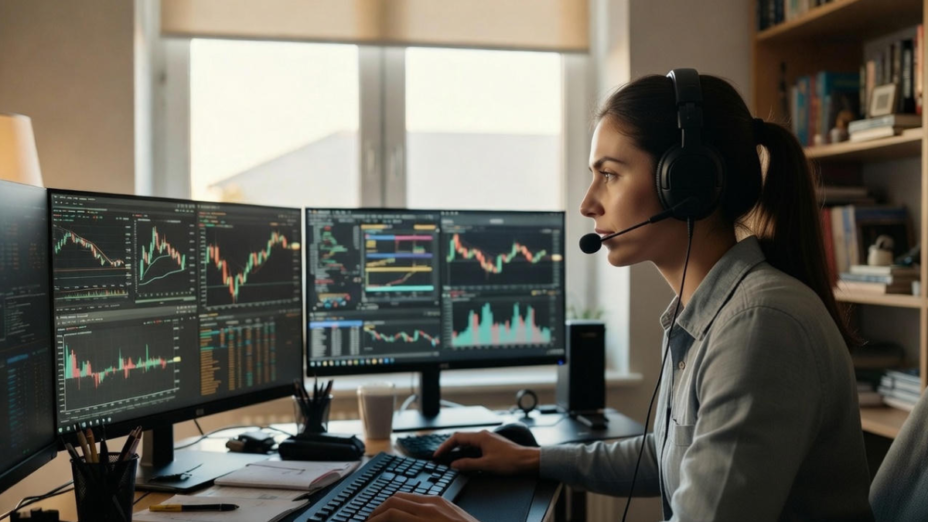
Trading in the Zone: The Mindset That Separates Winners from Everyone Else
When it comes to trading, most people focus on strategies, indicators, or how to manage risk. These are important, of course, but there is one thing that makes the biggest difference between consistent winners and everyone else: trading psychology. Thinking in terms of probabilities, controlling your emotions, and staying in the right mental state can make or break a trader’s career. This is the heart of what Mark Douglas teaches in his book Trading in the Zone.
Traders experience a wide range of emotions. Fear, anger, confusion, even overconfidence can creep in at any time. What Douglas noticed is that the most successful traders are the ones who execute their strategies without letting emotions interfere. It doesn’t matter whether they are using technical analysis or fundamental analysis. They adopt a mental state that allows them to act consistently, without fear or doubt. This state, according to Douglas, is called “trading in the zone.”
Understanding Positive Expectation
Every trader approaches the market with a positive expectation—they believe they will make money. Otherwise, why trade at all? Deep down, when a trade is placed, the trader hopes it will win. But what happens when a string of losses appears, breaking that expectation? This is when emotions take over. Anger, disbelief, or despair can set in, making the trader feel as if the market is against them.
A professional trader sees it differently. They know that both winning and losing streaks are part of the game. Their strategy has been tested over many trades, and they understand that, in the long run, they will come out ahead. Losses are seen as a necessary cost—like paying bills to keep a business running. This mindset removes the emotional rollercoaster that traps so many traders.
Accepting Risk Fully
One of the biggest gaps in trading is psychological. Most traders know there is risk, but few truly accept it. Accepting risk means fully embracing the possibility of losing money and moving on. The best traders understand that every trade is independent. A series of losses doesn’t mean the strategy is broken. A series of wins doesn’t mean they are invincible.
This brings us to Douglas’s five fundamental truths to help traders embrace uncertainty:
- Anything can happen.
- You don’t need to know what will happen next to make money.
- There is a random distribution of wins and losses.
- An edge is just a higher probability of one outcome over another.
- Every moment in the market is unique.
When a trader fully accepts these truths, they stop fearing losses and start trading confidently. They understand that probability, not certainty, drives success.
Beware the Gambler’s Fallacy
Many traders fall into the gambler’s fallacy—the idea that past outcomes affect the future. For example, if a coin lands on heads five times in a row, you know logically that the next toss is still 50/50. In trading, this mistake shows up when someone loses five trades and thinks their strategy is broken, or wins five trades and believes it is perfect.
Douglas emphasizes that every trade is independent. The outcome of the next trade is never determined by the previous trades. Accepting this randomness is critical. Once you do, you can plan your risk properly and maintain a calm mindset even during losing streaks.
Trading in the Zone
So what does it mean to trade in the zone? It’s a mental state of calm and confidence. A trader in the zone is not fearful, anxious, or impulsive. They wait patiently for the market to present opportunities that meet their strategy. When one appears, they execute it flawlessly.
This mindset doesn’t come from luck. It comes from preparation, discipline, and self-awareness. Douglas provides seven principles for trading consistently:
- Identify your setups clearly. Know exactly what conditions make a trade valid.
- Predefine your risk. Use stop losses and size positions before entering a trade.
- Accept the risks fully. Understand that any trade can lose and be ready to let it go.
- Execute without hesitation. Once a valid setup occurs, act decisively.
- Take profits as they come. Let the market reward you when conditions are favorable.
- Monitor and correct mistakes. Pay attention to habits that cost money and fix them.
- Respect all principles. Never ignore the rules you set for yourself.
Managing the Four Primary Trading Fears
Douglas identifies four main fears that keep traders from entering the zone:
- Fear of being wrong
- Fear of losing money
- Fear of missing out
- Fear of leaving money on the table
Most mistakes in trading come from these fears. They push traders to act impulsively or overtrade. Learning to accept uncertainty and control these fears is the key to trading calmly and consistently.
Thinking in Probabilities
Trading is not about predicting the market. It is about thinking in terms of probabilities. You cannot know exactly what will happen next, but you can define the odds of success. Every trade is a chance event. Some will win, some will lose. The goal is to ensure that, over many trades, your strategy has a positive expectation.
When you embrace this perspective, losing trades no longer cause panic. You understand that a few losses are part of the process. You focus on executing your strategy well, not on avoiding losses entirely.
The Takeaway
Trading in the zone is about mastering your mind. It’s about accepting uncertainty, controlling emotions, and thinking probabilistically. It’s about being patient and disciplined, waiting for the setups that truly match your strategy, and ignoring everything else.
When you trade in the zone, money comes naturally—not because you are forcing trades or chasing the market, but because you are executing your strategy calmly, consistently, and confidently. The real power in trading comes not from doing more, but from doing only what is right, and nothing else.
⚠️ Not Financial Advice
The information in this post is for educational purposes only. It does not constitute a recommendation to buy or sell any security. Financial markets involve high risk; you could lose your entire capital. Seek professional advice for your specific situation.